Lesson 8:

Gears equation.
The following equation establishes the relationship between the angular speed and the number of teeth of the two wheels of a gear:
\huge Z_1 \cdot n_1 = Z_2 \cdot n_2Therefore, the number of teeth of the driving wheel (Z1) times its speed (n1) is always equal to the number of teeth of the driven wheel (Z2) times its speed (n2).
This equation allows to solve many problems in which three of the four terms are known, similar to what happened with the Law of the Lever.
Problems with gears:
Problem 12: calculate the speed of the driven wheel knowing that the driving one rotates at 300rpm.
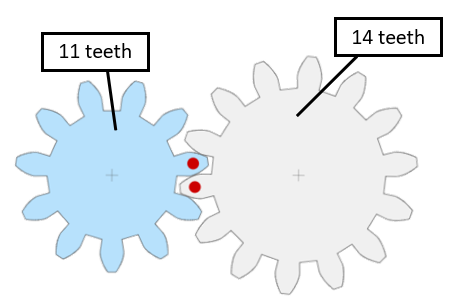
Data:
You need to use the Gears equation:
\normalsize Z_1 \cdot n_1 = Z_2 \cdot n_2 \normalsize 11 \cdot 300 = 14 \cdot n_2 \normalsize n_2=\dfrac{11 \cdot 300}{14} =235,71rpmSolution: \normalsize \mathbf{ n_2=235,71rpm}
Problem 13: the angular speed of the driving wheel of a gear is 50rpm. Calculate the number of teeth of that wheel if the driven wheel has 40 teeth and must rotate at 20rpm.
Data:
You need to use the Gears equation:
\normalsize Z_1 \cdot n_1 = Z_2 \cdot n_2 \normalsize Z_1 \cdot 50 = 40 \cdot 20 \normalsize Z_1=\dfrac{40 \cdot 20}{50} =16Solution: \normalsize \mathbf{ Z_1=16 teeth}
Problem 14: calculate the speed at which the driving wheel of the image must rotate if we want the driven wheel to rotate at 850rpm.
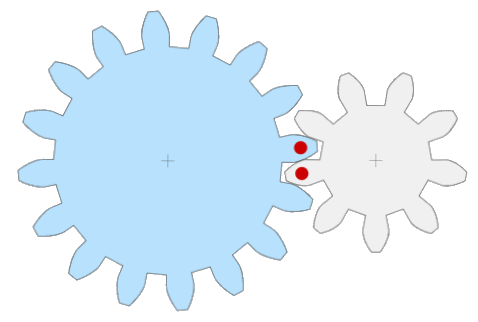
Data:
You need to use the Gears equation:
\normalsize Z_1 \cdot n_1 = Z_2 \cdot n_2 \normalsize 16 \cdot n_1 = 9 \cdot 850 \normalsize n_1=\dfrac{9 \cdot 850}{16} =478,13rpmSolution: \normalsize \mathbf{ n_1=478,13rpm}
Problem 15: it is known that the driving wheel of a gear rotates at 65rpm and has 15 teeth, and that the driven wheel rotates at 39 rpm. What’s the number of teeth of the driven wheel?
Data:
You need to use the Gears equation:
\normalsize Z_1 \cdot n_1 = Z_2 \cdot n_2 \normalsize 15 \cdot 65 = Z_2 \cdot 39 \normalsize Z_2=\dfrac{15 \cdot 65}{39} =25Solution: \normalsize \mathbf{ Z_2=25teeth}
*Problems 5 to 10.