Lesson 7:

Gears and their parts.
The mechanism formed by two toothed wheels that are meshed is called a gear. In a gear, there is always a wheel that transmits the movement to the other, so we differentiate:
- The driving wheel (also called driver wheel): which is connected to a source of power such as a motor and transmits the movement to another wheel. It is usually identified with the number 1.
- The driven wheel (also called follower): which is the one that receives the movement. It is usually identified with the number 2.
Usually, when drawing gears, the driving wheel is placed on the left, though that is not necessary.
As shown in the picture below, the toothed wheels of a gear rotate around a shaft of axis:
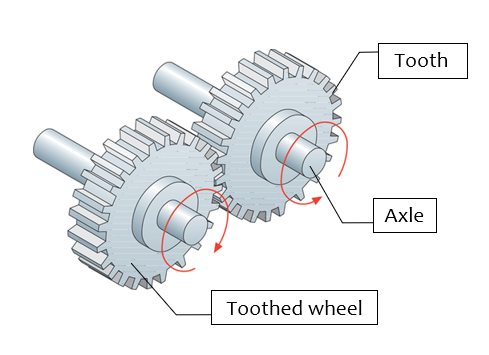
Types of gears.
In all the gifs on this page the driving wheel is colored in blue and placed on the left. Now we’ll see how the size (number of teeth) of the driving and the driven wheel affect the movement of a gear.
Multiplying gears.
Are those gears in which the driving wheel (blue) has more teeth than the driven wheel. That means that the gear will increase the speed, so the driven wheel will rotate faster than the driving wheel.
In this gif you can see a gear in which the driving wheel has 20 teeth and the driven wheel has 10 teeth. If you look at the speed of both wheels (the red dot can help you) you will realize that each time the blue wheel rotates once, the small one rotates twice. Therefore, the angular speed of the driven wheel is twice that of the driving wheel: the speed has been multiplied by two.

Reducing gears.
Are those gears in which the driving wheel (blue) has fewer teeth than the driven wheel. That means that the gear will reduce the speed, so the driven wheel will rotate slower than the driving wheel.
In the following gif you can see a gear in which the driving wheel has 10 teeth and the driven wheel has 30 teeth. If you look at the angular speed of each wheel, you will realize that each time the blue wheel rotates once, the big one only makes a third of a turn. Therefore, the angular speed of the driven wheel is one third that of the driving wheel, or said in another way, the driving wheel rotates three times faster than the driven wheel: the speed has been divided by three (or multiplied by a third, it’s just the same).

Gear ratio.
The gear ratio of any gear is a value that allows us to know if it is a multiplying or reducing gear. It is calculated as:
\huge GR= \dfrac{n_2}{n_1}That is, dividing the angular speed of the driven wheel (n2) by the angular speed of the driving wheel (n1). Remember that the letter n represents the angular speed in revolutions per minute (rpm).
You can also calculate the gear ratio using the number of teeth of each wheel. From now on, will identify the number of teeth in a toothed wheel with the letter Z. Therefore, Z1 will be the number of teeth of the driving wheel and Z2 the number of teeth on the driven wheel:
\huge GR= \dfrac{Z_1}{Z_2}Be careful! As you can see, in this case, the order is the opposite, since you have to divide the number of teeth on the driving wheel by the number of teeth on the driven wheel.
What is the relationship between the gear ratio and the type of gear?
- If GR > 1: the gear will be a multiplying one. For instance: GR = 2 or GR = 4.
- If 0 < GR < 1 (the GR is in between 0 and 1): the gear will be a reducing one. For instance: GR = 0,5 or GR = 0,3.
If the gear ratio is exactly one, it means that both wheels have the same number of teeth and therefore the same speed. That is not something usual, since gears are used to either increase or decrease the speed of a motor.
Let’s solve some problems:
Problem 9: calculate the gear ratio of a gear whose driving wheel rotates at 120rpm and whose driven wheel rotates at 30rpm.
Data:
You can directly enter the data into the equation:
\normalsize GR= \dfrac{n_2}{n_1} \normalsize GR= \dfrac{30}{120}=\dfrac{1}{4}=0,25Solution: \normalsize \mathbf{ GR= \dfrac{1}{4}=0,25}
Problem 10: calculate the gear ratio of each gear counting the number of teeth of each wheel:
Note: the driving wheel is the blue one.
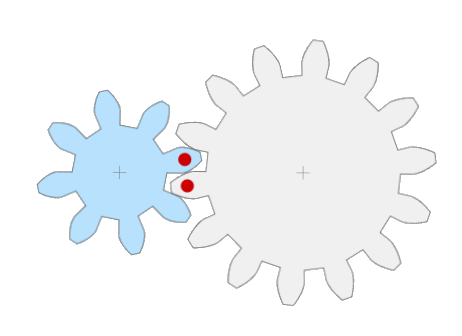
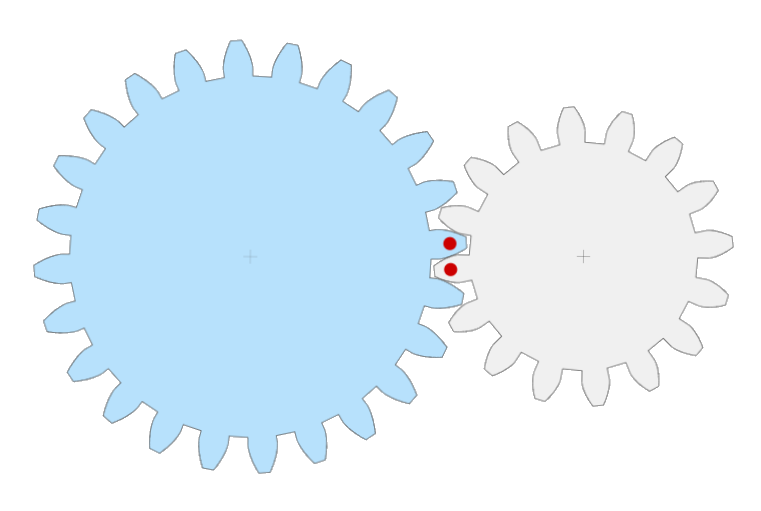
The driving wheel has 8 teeth (Z1=8) and the driven wheel 14 (Z2=14), therefore:
\normalsize GR= \dfrac{Z_1}{Z_2} = \dfrac{8}{14}=\dfrac{4}{7} \approx 0,57Solution: \normalsize \mathbf{ GR= \dfrac{4}{7} \approx 0,57}
The driving wheel has 24 teeth (Z1=24) and the driven wheel 16 (Z2=16), therefore:
\normalsize GR= \dfrac{Z_1}{Z_2} = \dfrac{24}{16}=\dfrac{3}{2} = 1,5Solution: \normalsize \mathbf{ GR= \dfrac{3}{2} = 1,5}
Problem 11: a gear with a gear ratio of 2,5 must be assembled. Calculate the number of teeth of the driven wheel if the driving one must necessarily have 30 teeth.
Data:
In this case, the gear ratio is known, but the same equation must be used:
\normalsize GR= \dfrac{Z_1}{Z_2} \normalsize 2,5= \dfrac{30}{Z_2} \normalsize 2,5 \cdot Z_2 = 30 \normalsize Z_2= \dfrac{30}{2,5}=12Solution: \normalsize \mathbf{ Z_2= 12}
*Problems 1 to 4.