Lesson 5:

The law of the lever.
In addition to transforming a linear movement into another linear movement, levers allow large loads to be overcome with small efforts. For example, levers allow lifting very heavy objects with little effort. On this page, we are going to learn how to calculate what force (effort) must be exerted on a given lever to overcome a load.
The equation that we are going to use is known as the Law of the Lever:
\huge E \cdot E_{a}=L \cdot L_{a}According to this equation, any lever will be balanced when the effort multiplied by the effort arm equals the load multiplied by the load arm. In that case, the lever will not move in any direction.
In any other case the lever will move towards one of the sides:
a) Towards the effort side when:
\huge E \cdot E_{a} > L \cdot L_{a}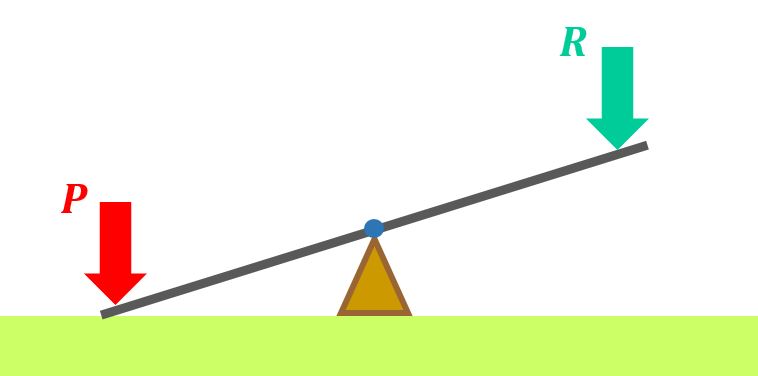
b) Or towards the load side when:
\huge E \cdot E_{a} < L \cdot L_{a}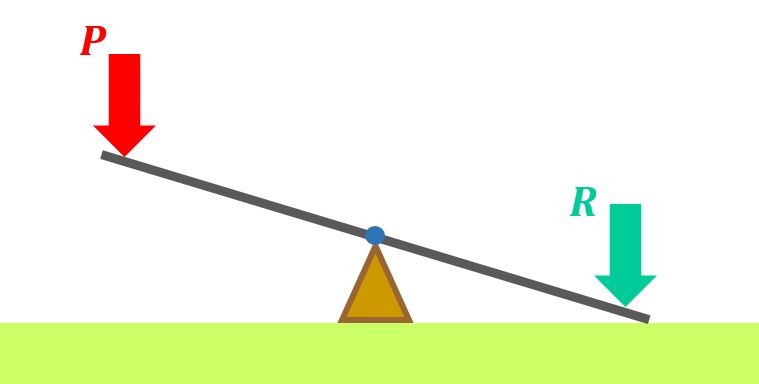
In this animation all parameters that affect the lever can be modified. Note that a message appears indicating that the lever is in equilibrium when the law of the lever is fulfilled (you can click on any of the sliders and use the keyboard arrows to vary the values precisely):
Very important! Note that, as explained above, the lever stays still when balanced, but it doesn’t necessarily have to be horizontal. The position of the platform of a balanced lever will depend on where the lever was when it became balanced. Thinking that the platform needs to be horizontal for the lever to be in balance is completely wrong.
Which units of measurement are we going to use?
Before starting to solve problems using the Law of the Lever, you must know the units of measurement that will be used in these problems. As you have seen, the Law of the Lever has four terms:
- The effort and the load: which are forces.
- The effort arm and the load arm: which are lengths (distances).
As any other length, longitud, the effort arm and the load arm are measured in meters (m). The meter is the main unit for length, therefore if any other length unit, suchs as centimeters or milimeters, appear in a problem, the first thing to do will be converting them into meters.
But… what unit is used to measure forces?
The main unit for measuring forces is the newton (N). As you can imagine, this unit was named after the famous scientist Isaac Newton, thanks to whom the Law of Gravity was developed.
As it happens with all units, multiples and submultiples can also be used. For example:
- 1kilonewton = 1000 newtons (1kN = 1000N).
- 1 centinewton = 0,01 newtons (1cN = 0,01N).
You must realize that, when talking about the unit, newton is writen with a lower case «n», while a capital letter is used to talk about the scientist (Isaac Newton). However, its symbol (N) and the symbols of its multiples and submultiples must be writen with a capital letter «n».
This is always like this when a unit is named after a person. The same happens, for example, with volt (V), named after Alessando Volta, curie (Ci), named after Marie and Pierre Curie, or farad (F), named after Michael Faraday.
Law of the lever exercises.
Problem 1: a box that weighs 500 N must be lifted with the lever of the image. Calculate the force (effort) that must be exerted in the opposite edge.?
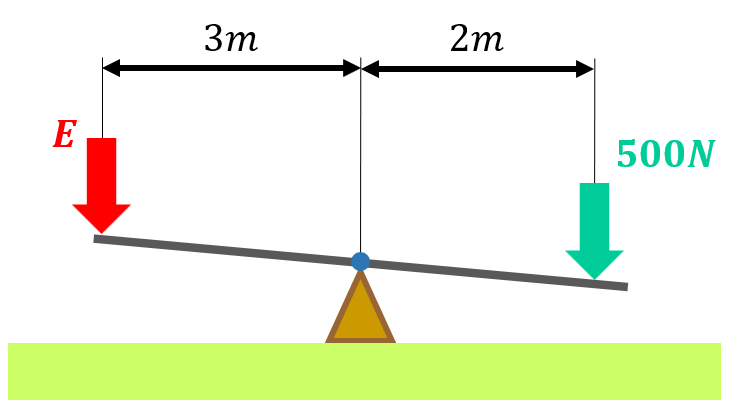
Data:
Finally, you must solve for E:
\normalsize E = \dfrac {500 \cdot 2}{3}=\dfrac{1000}{3}=333,33\ NResult: \normalsize \textbf{E = 333,33N}
As you can see, three out of the four terms of the equation must be known beforehand in order to calculate the unknown one.
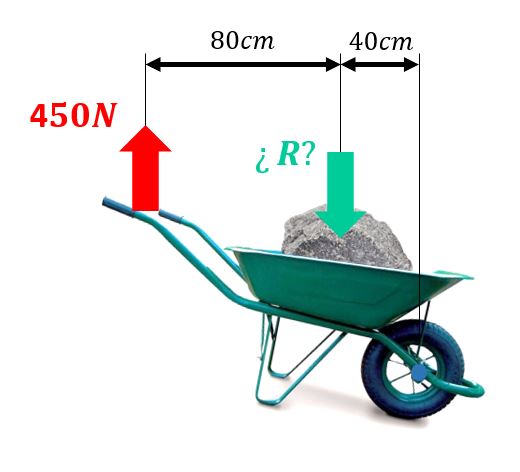
Problem 2: you want to lift some rocks using a wheelbarrow like the one in the image and the maximum effort that you can exert is 450N. Calculate the maximum load that you will be able to lift?
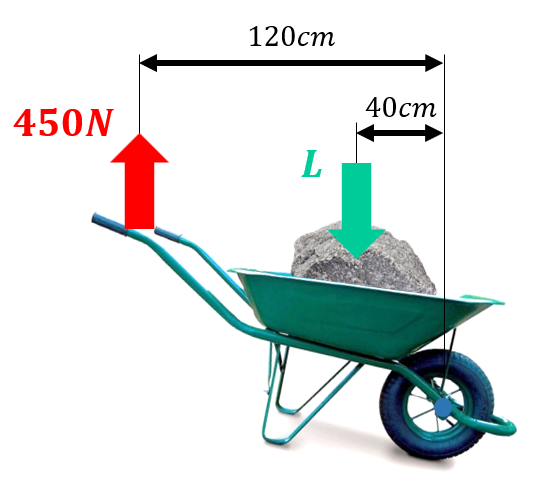
Data:
Finally, clearing the load:
\normalsize L = \dfrac {450 \cdot 1,2}{0,4}=\dfrac{540}{0,4}=1350\ NResult: \normalsize \textbf{L = 1350N}
Be careful! This other drawing could have been given and the result would have been exactly the same. Realize that, in this case, the effort arm is equal to 80+40=120cm (distance from the effort to the fulcrum). Don’t commit the mistake to consider that the effort arm is just 80 cm
In some cases, you might also need to clear the length of the effort arm or the load arm. Let’s see two examples:
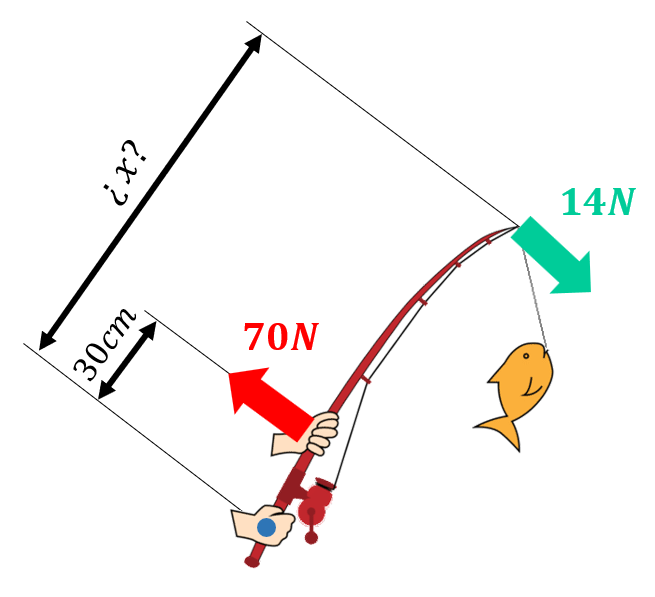
Problem 3: imagine a fish of 14N has been caught with the fishing rod of the image. Calculate the length of the fishing rod if a force of 70N is needed to lift the fish.
Help: in this case, the lower hand works as a fulcrum while the upper hand is the one that exerts the force upwards.
Data:
Solving for La:
\normalsize L_{a} = \dfrac {70 \cdot 0,3}{14}=\dfrac{21}{14}=1,5\ mSolution: \normalsize \mathbf{L_a = 1,5\ m}
As you can see in the image the length of the fishing rod is the same than the load arm, so the problem is solved.
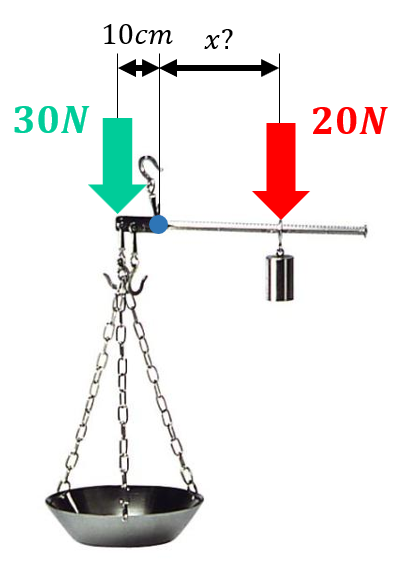
Problem 4: calculate the distance at which the weight of the steelyard must be placed in order to balance a load of 30 newtons (weight of the fruit placed on the plate) if a weight of 20N is being used and the distance from the load to the fulcrum is 10cm.
Data:
Solving for Ea:
\normalsize E_{a} = \dfrac {30 \cdot 0,1}{20}=\dfrac{3}{20}=0,15\ mResult: \normalsize \mathbf{E_a = 0,15\ m}