Lesson 4:

The lever and its parts.
A lever is made of two main elements:
- A platform: which can be a rigid bar or a plate.
- A fulcrum: which is the point that supports the platform.
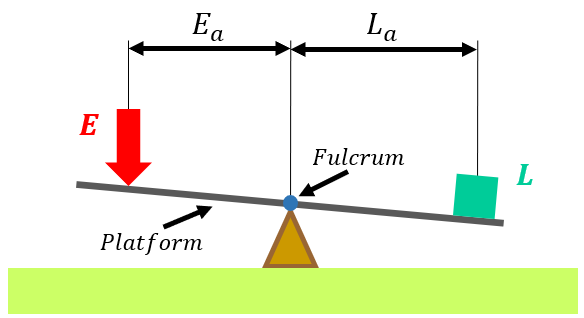
As it was explained on the first page of the unit, a lever is a linear transmission mechanism as both, input and output movements, are linear. Two forces act on any lever:
- The force to be overcome is called load, and it is represented with the letter L. Usually that load is the weight of an object that must be lifted, but, as we’ll see later, that is not always the case.
- The force that is exerted in order to overcome the load is called the effort, and it is represented with the letter E. usually, that the effort is exerted by a person, but sometimes it is a machine, or even another object, the one that exerts it.
In summary, in all levers, a load (L) exits that must be overcome by another force, called effort (E).
As they are forces, both, effort and load, are represented with arrows. This is the way forces are always represented in physics.
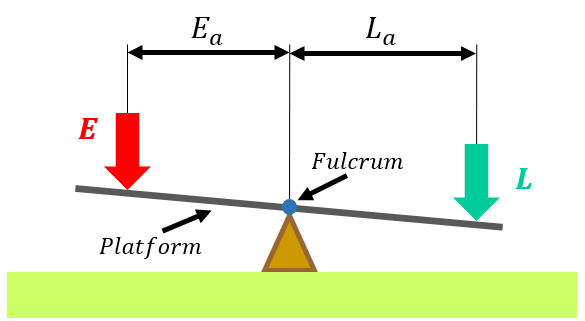
We still need to define two concepts that have appeared in the previous iamges:
- The distance between the fulcrum and the point where the effort is applied is called effort arm and we’ll be represented with the letters Ea.
- The distance between the fulcrum and the point where the load is placed is called load arm and we’ll be represented with the letters La.
These two distances we’ll be used to solve problems related witH levers, as we’ll see on the next page.
The three types of lever:
Depending on the position of the effort, the load and the fulcrum three different types of lever can be distinguished. The easiest way to know what kind of platform we are working with is to look at the element that is placed in the middle of the other two:
- First class lever: when the fulcrum is in between the effort and the lever.
- Second class lever: when the load is in between the effort and the fulcrum.
- Third class lever: when the effort is in between the load and the fulcrum.
FIRST CLASS LEVER
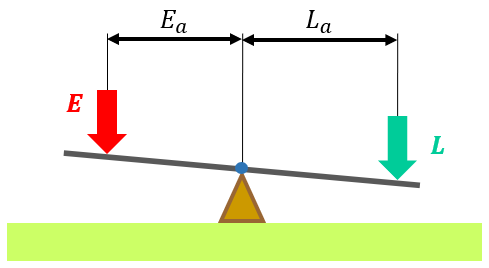
Fulcrum between effort and load.
SECOND CLASS LEVER
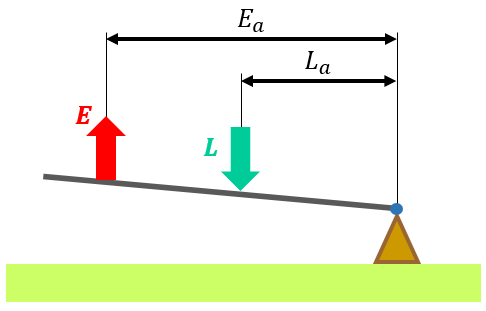
Load between effort and fulcrum.
THIRD CLASS LEVER
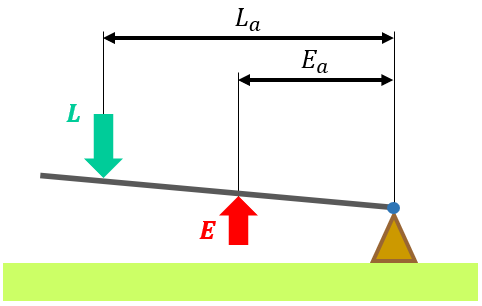
Effort between load and fulcrum.
Now, some objects that work as levers of the three different classes we’ll be analyzed:
- First class lever objects:
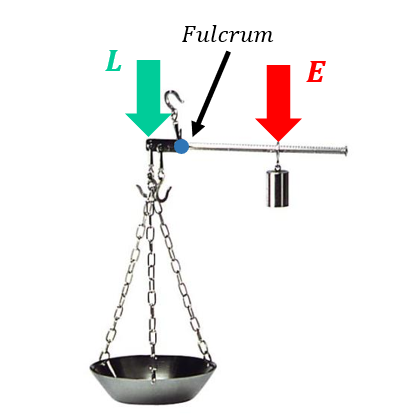
A typical example of this type of lever are balances that are used to weigh fruit, or other products, in markets. As you can see in the picture, they consist of a weight that exerts a downward force (effort) in order to compensate the weight (resistance) of the products that are placed on the plate. The fulcrum is in the middle, as in all first degree levers, and both forces point in the same direction:
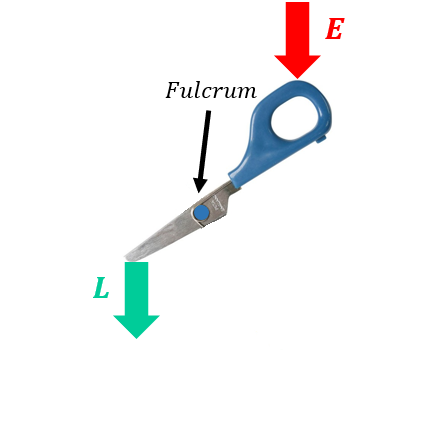
Another good example of first class levers are scissors. However, in this case, they consist of two levers that share the same fulcrum. The effort is the force that is exerted in the grips of the scissors while the load is exerted by the object that we are trying to cut. It is easier to analyze its different parts if we only look at one of the scissors blades (image on the right):

- Second class lever objects:
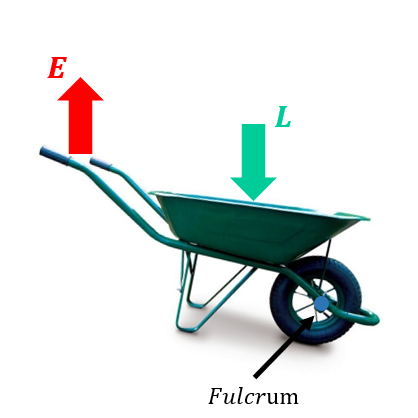
Wheelbarrows, which allow weights to be transported easily, are one of the best examples of this type of lever. The effort is exerted on the grips of the wheelbarrow while the load corresponds to the weight of the object being transported. On the other hand, the fulcrum is located in the center of the wheel, since it is the point around which the wheelbarrow rotates:
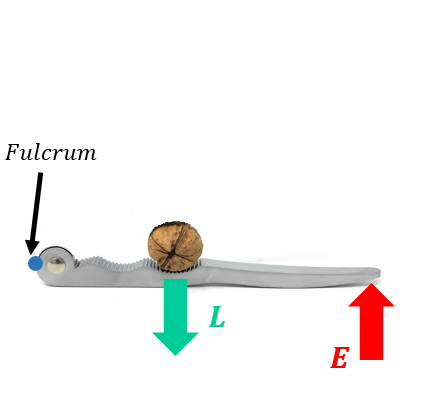
A nutcracker is made up of two second class levers that, as in the case of scissors, share the same fulcrum. The effort is exerted on its grips, inwards, and the load is exerted by the nut, outwards. As you can see, the load is in the middle, and that effort and load have opposite directions, as it always happens with second class levers.

- Third class lever objects:
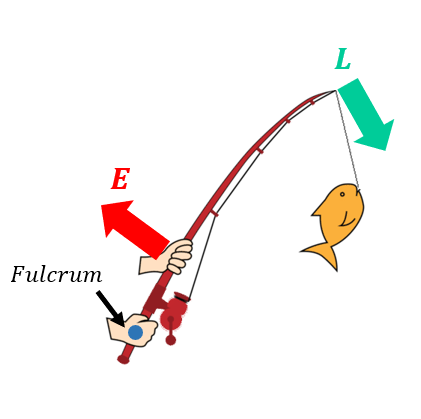
Fishing rods are a good example of third class lever in which the effort is in between the fulcrum and the load. As seen in the image, the effort is exerted by the fisherman upwards while the fish (load) pulls the rod downwards. The other hand, on which the rod rests, is the one that works as a fulcrum:
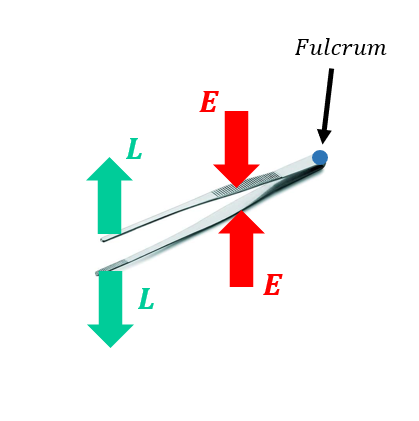
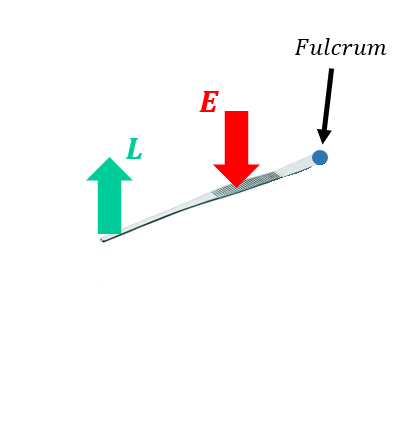
Lastly, there are also examples of double third class levers. A pair of tweezers consists of two third class levers that share the same fulcrum in one edge. In this case, the effort is exerted with your fingers in the middle and inwards, while the load is placed at the edge, where an object is being trapped, and points outwards.