Lesson 6:

The differences between weight and mass.
In the previous problems we have seen that forces are measured in newtons. In fact, we have done a problem in which a fruit weighing 30 newtons had to be balanced on a scale. However, it is not usual to ask for 30 newton of fruit in the shopping center, we are more used to asking for a 1, 2, 3, 4 kilograms of whatever we want to buy…
Then, why is not weight measured in kilograms? Is it wrong to ask for a 2kg watermelon in the greengrocer? Is it correct to say that my weight is 50, 60 or 70 kilograms?
In order to answer all these questions you must understand the difference between two completely different physical quantities:
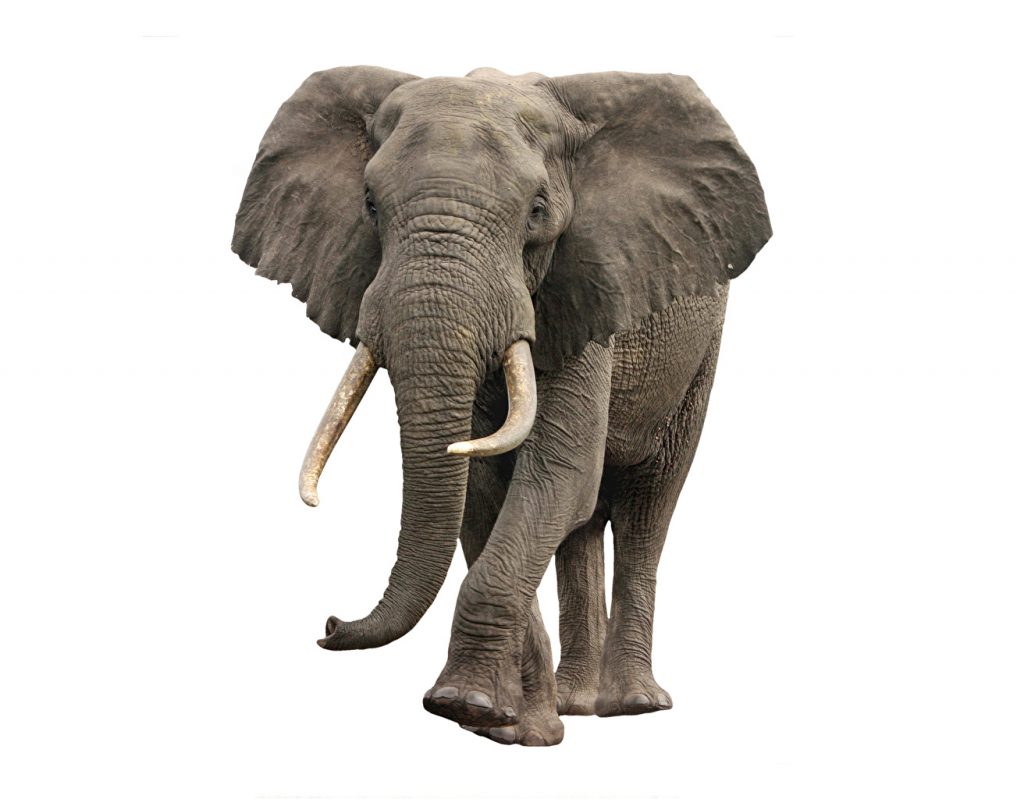
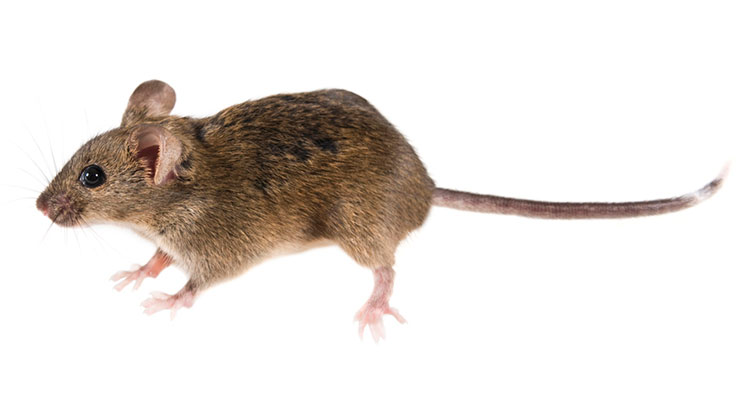
- Mass: which is the quantity of matter in a physical body and is measured in kilograms (abbreviated kg). A body will have more mass than another if it is made up of more atoms. If you don’t remember what an atom is, you can remember it here, but, in summary, atoms are the particles that make up everything around us. They are so tiny that it is not possible to count the number of atoms in a body one by one. However, I am sure that you would not hesitate if asked whether an elephant or a mouse has a bigger mass.
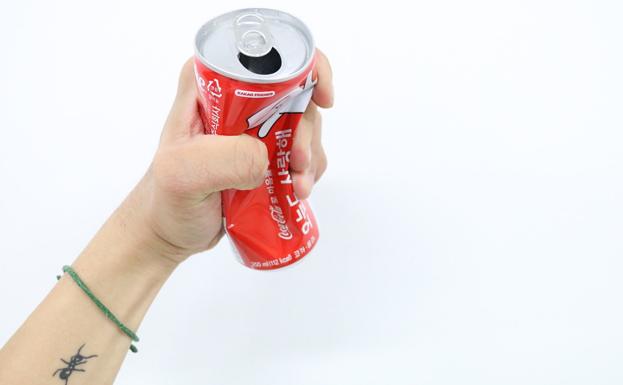
- Force: which is everything that can change the speed of a body or deform it. As we have seen on the previous page, force is measured in newtons (abbreviated N). An example of force is the one we exert when we kick a ball (causing its speed to change) or when we crush a coke can (since we are deforming it).

As you have seen, mass and force are completely different concepts, but, what is the weight of an object?
- Weight is a type of force. Specifically, it is the force with which some bodies attract other bodies. And since it is a type of force, it should always be measured in newtons (N).
Many years ago (in 1687), Isaac Newton discovered that all bodies attract each other. That’s right, the computer on your desk and the lamp in your room are constantly attracting each other. And the same happens with any couple of objects you can think of.
But, if all things are attracting each other, why don’t they end up coming together? The answer is simple, we do not realize that objects attract each other because that force that Newton discovered is greater the larger the objects that come into play. For small objects such as those that usually surround us, that attraction is very weak and therefore it is not enough to make move them.
However, there is one physical body that due to its huge size, attracts all the objects around us and even ourselves: the Earth. When we drop a plate on the ground, we are only experiencing the force of attraction between the Earth and that plate. As we have seen before, that attraction is mutual. In fact, the plate is also attracting the Earth, but since the Earth is much larger than the plate, it is the plate the one that moves towards the Earth and not the other way around.
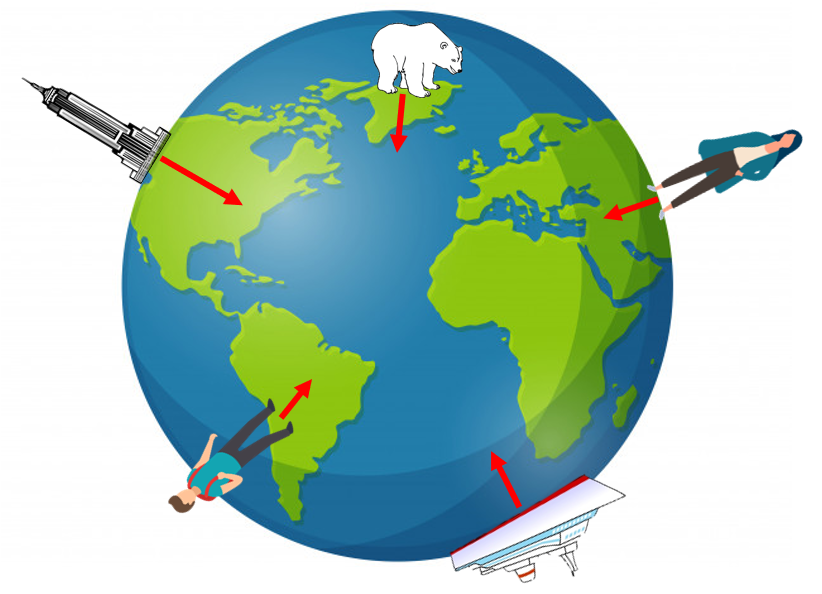
Therefore, from now on, you must remember that the weight of any person, animal, object… is the force with which the Earth attracts it towards its center. That force is greater the larger the body is. In fact, the force with which the Earth attracts each of the bodies on its surface depends on its mass. The greater the mass, the greater the force, or said in another way, the greater the mass, the greater the weight. In the image below, the weights of different bodies have been represented with arrows, which, in all cases, point towards the center of our planet:
Up to this point, we have said that the more mass a body has, the greater its weight will be, however we have not explained how the weight of an object or any other body can be calculated. Fortunately, it is very simple. You just have to use the following equation:
\huge Weight = 9,8 \cdot mLet’s see an example:
Problem 5: calculate the weight of a 5kg watermelon.
\normalsize W = 9,8 \cdot m = 9,8 \cdot 5 =\mathbf{49 \ N}Solution: its weight is 49 N.
Now we are going to understand where that 9.8 that appears in the equation to calculate the weight comes from. In fact, though we have not said it before, that equation is just valid to calculate the weight of an object over the surface of the Earth. In most cases we deal with objects that are on the Earth, and therefore knowing that equation is enough.
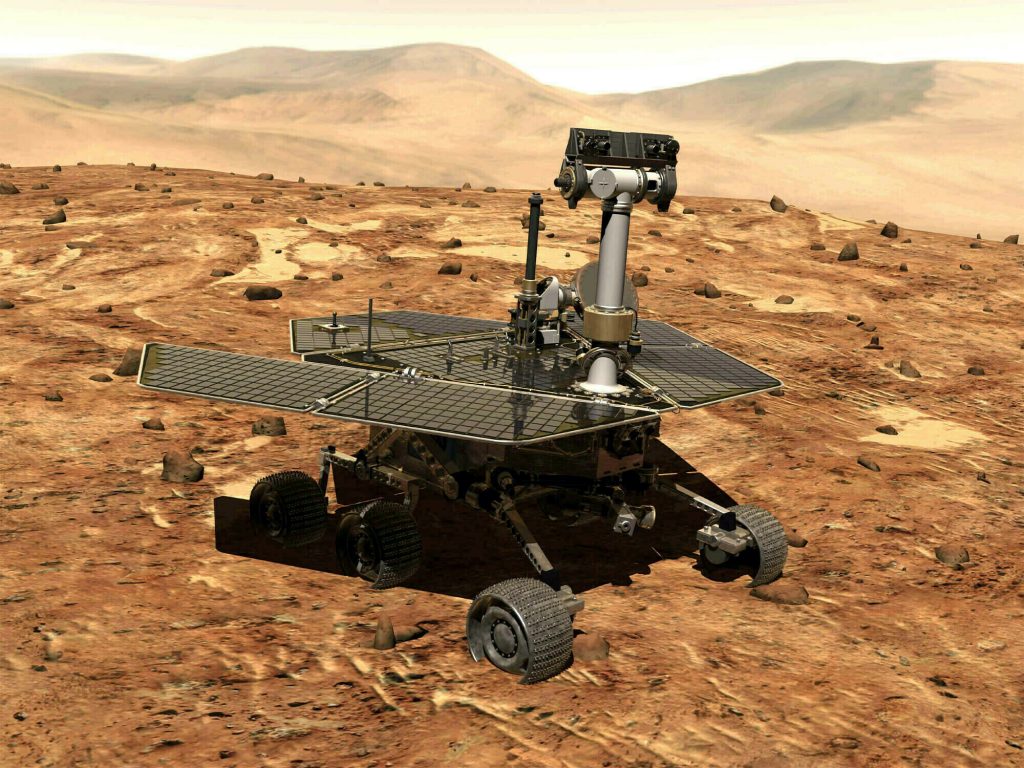
However, if we want to calculate the weight of a body that is on another planet (Mars, Jupiter…), on the moon or on other celestial body, we would have to use a different value. This value is called gravitational acceleration and takes different values depending on the planet or celestial body. Considering that fact is important, for example, when designing a robot that has to move on the surface of Mars, as happened with the Opportunity robot (image on the right) that was able to explore the surface of Mars for 15 years. In the table below you can see the different values of the gravitational acceleration of some celestial bodies:
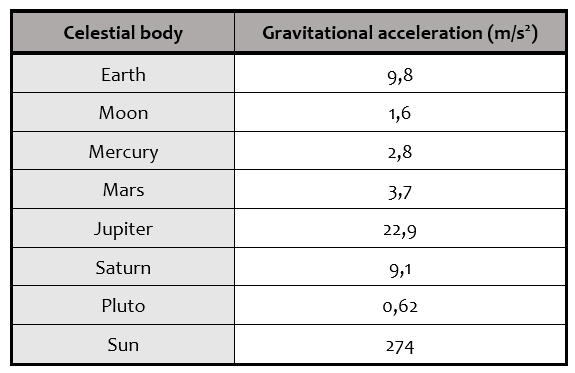
As you can see in the table, the acceleration of gravity, as any other acceleration, is measured in meters per second squared (m/s2).
Problem 6: calculate the weight of a watermelon whose mass is 5kg in the following two cases:
a) If it is on the Moon:
\normalsize W= 1,6 \cdot m = 1,6 \cdot 5 =\mathbf{8 \ N}Solution: its weight on the Moon is 8 N.
b) If it is on the surface of Jupiter:
\normalsize W= 22,9 \cdot m = 22,9 \cdot 5 =\mathbf{114,5 \ N}Solution: its weight on the surface of Jupiter is 114,5 N.
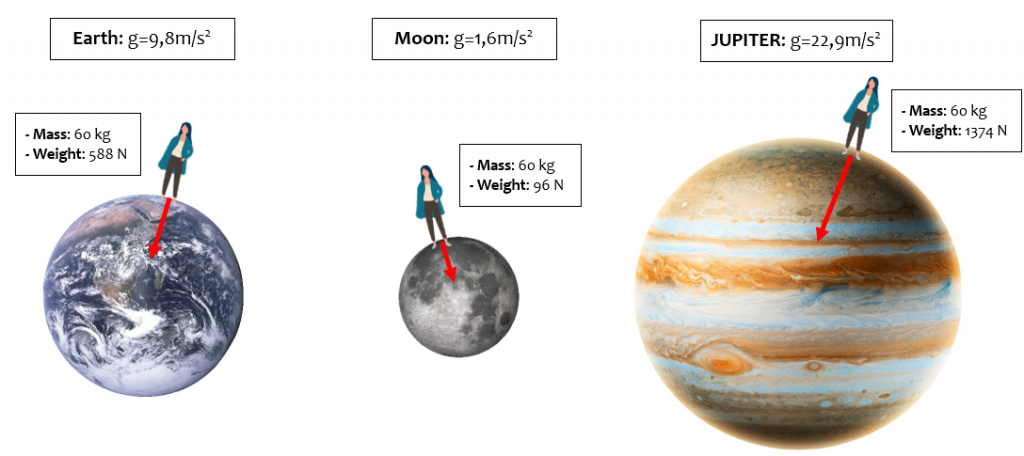
Exactly the same that happens with that watermelon would happen with a person. For instance, the weight of a girl with a mass of 60kg would be completely different depending on the place where she is, while her mass would be the same no matter where she is:
To finish we are going to answer the questions we asked ourselves at the beginning of this page:
Why the weight is not measured in kilograms?
The answer is easy, the weight of a body is a force and therefore must be measured in Newtons.
Is it wrong to ask the greengrocer for two kilograms of fruit?
Not really, it is perfectly right to ask for some kilograms of fruit as you are just indicating the mass of the fruit. It would also be correct to ask for 19,6 newtons of fruit (2 x 9,8 = 19,6) though it is not usually said and the greengrocer would probably not understand you.
And, is it right to say that I weight 70 kilograms?
In this case, the answer is no. It is wrong to measure weight in kilograms, as it should be measured in Newtons. The right way to express that idea would be: «I’ve got a mass of 70 kilograms» or «My weight is 686 newtons (70 x 9,8 = 686)».
Exercises of levers with weights.
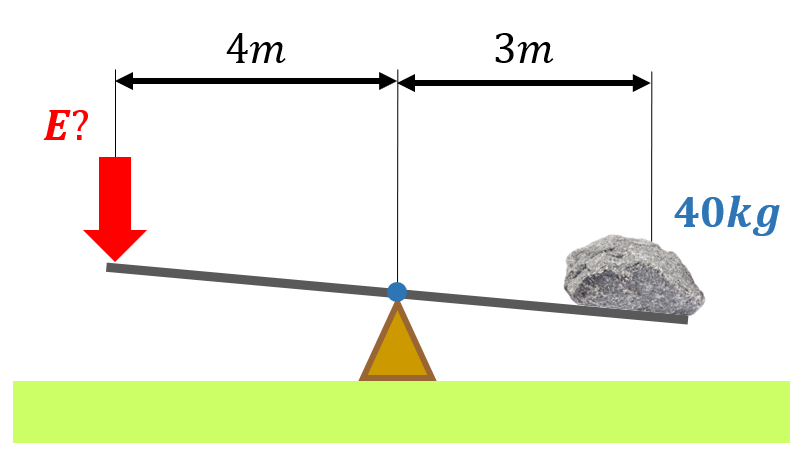
Problem 7: calculate the force that must be exerted in the lever to lift a rock of 40kg.
Data:
First, you need to calculate the load (L) which is the weight of the rock:
\normalsize L = W=9,8 \cdot m=9,8 \cdot 40=\mathbf{392 \ N}Now we can use the Law of the Lever
\normalsize E \cdot E_{a}=L \cdot L_{a}Therefore:
\normalsize E \cdot 4=392 \cdot 3So the effort needed is:
\normalsize E = \dfrac {392 \cdot 3}{4}=\dfrac{1176}{4}=294\ NSolution: \normalsize \textbf{E = 294\ N}
Problem 8: calculate the mass of the rock that must be placed on the left edge of the lever to lift the box on the right, whose weight is 950 N.
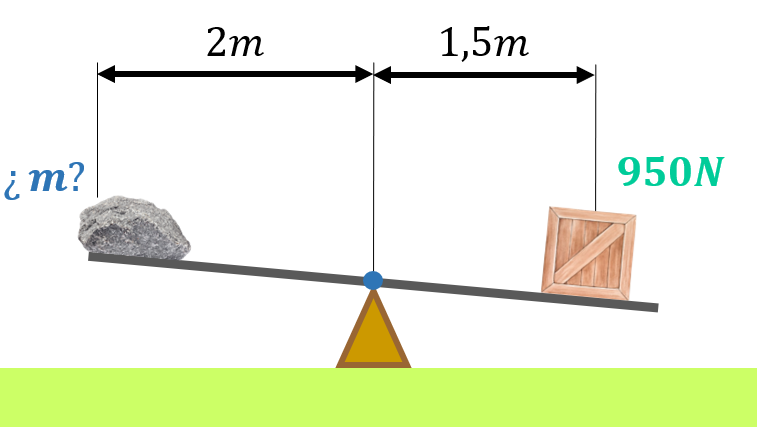
Data:
Ehe effort needed to lift the box can be calculated as we know three of the four terms of the Law of the Lever:
\normalsize E \cdot E_{a}=L \cdot L_{a} \normalsize E \cdot 2=950\cdot 1,5Now you can calculate the effort:
\normalsize E = \dfrac {950\cdot 1,5}{2}=\dfrac{1425}{2}=712,5\ NFinally, you must calculate the mass of a stone that weighs 712,5 N:
\normalsize W=9,8 \cdot m \normalsize 712,5=9,8 \cdot m \normalsize m= \dfrac{712,5}{9,8} = \textbf{ 72,7\ kg}Solution: \normalsize \textbf{m = 72,7 \ kg}