Lesson 10:

Gear trains problems.
Knowing how to calculate the gear ratio of any gear train allows you to solve the following problems in which you are asked to get the speed of the last wheel knowing the speed of the first one and the number of teeth of each wheel. Let’s see how to do it:
Simple gear trains problems.
Problem 16: calculate the speed of the last wheel knowing that the first wheel is connected to an electrical motor that rotates at 50rpm. Then, draw arrows to indicate the direction of rotation of each wheel (clockwise or counterclockwise).
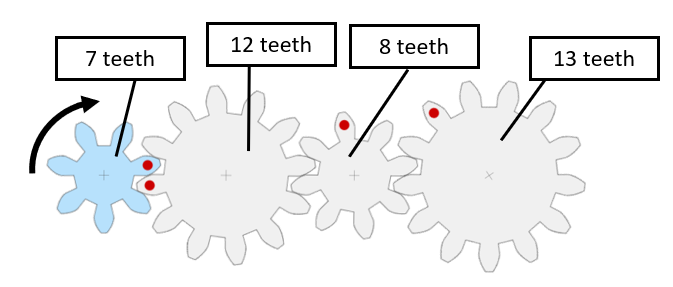
Data:
You need to use the Simple Gear trains equation to calculate the gear ratio:
\normalsize GR= \dfrac{Z_{first}}{Z_{last}} \normalsize GR= \dfrac{7}{13}=0,54Once you know the gear ratio the speed of the last wheel can be easily calculated knowing that, for all gear trains:
\normalsize GR=\dfrac{n_{last}}{n_{first}} \normalsize 0,54=\dfrac{n_{last}}{50} \normalsize n_{last}=0,54 \cdot 50 =27rpmSolution: \normalsize \mathbf{ n_{last}=27rpm }
Problem 17: calculate the speed of the last wheel knowing that the first one rotates at 85rpm. Then, draw arrows to indicate the direction of rotation of each wheel (clockwise or counterclockwise).
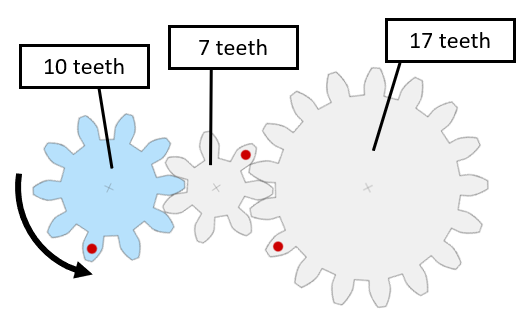
Data:
You need to use the Simple Gear trains equation to calculate the gear ratio:
\normalsize GR= \dfrac{Z_{first}}{Z_{last}} \normalsize GR= \dfrac{10}{17}=0,59Once you know the gear ratio the speed of the last wheel can be easily calculated knowing that, for all gear trains:
\normalsize GR=\dfrac{n_{last}}{n_{first}} \normalsize 0,59=\dfrac{n_{last}}{85} \normalsize n_{last}=0,59 \cdot 85 =50,15rpmSolution: \normalsize \mathbf{ n_{last}=50,15rpm }
Compound gear trains problems.
Problem 18: calculate the speed of the last wheel knowing that the first one is connected to the engine of a car that rotates at 1800rpm. Then, draw arrows to indicate the direction of rotation of each wheel (clockwise or counterclockwise).
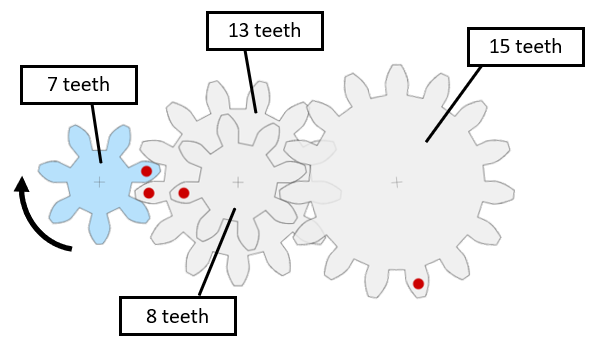
Data:
You need to use the Compound Gear trains equation to calculate the gear ratio:
\normalsize GR= \dfrac{Z_1 \cdot Z_3}{Z_2 \cdot Z_4} \normalsize GR= \dfrac{7 \cdot 8}{13 \cdot 15}=\dfrac{56}{195}=0,29Once you know the gear ratio the speed of the last wheel can be easily calculated knowing that, for all gear trains:
\normalsize GR=\dfrac{n_{last}}{n_{first}} \normalsize 0,29=\dfrac{n_{last}}{1800} \normalsize n_{last}=0,29 \cdot 1800 =522rpmSolution: \normalsize \mathbf{ n_{last}=522rpm }
Problem 19: calculate the speed of the last wheel knowing that the first one is connected to the blades of a windmill whose blades rotate at 15rpm. Then, draw arrows to indicate the direction of rotation of each wheel (clockwise or counterclockwise).
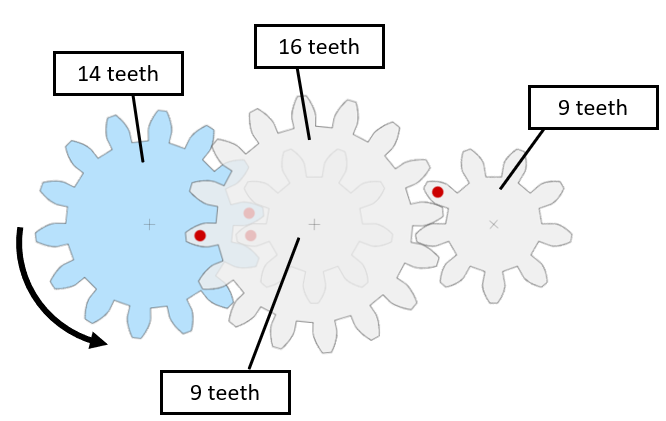
Data:
You need to use the Compound Gear trains equation to calculate the gear ratio:
\normalsize GR= \dfrac{Z_1 \cdot Z_3}{Z_2 \cdot Z_4} \normalsize GR= \dfrac{14 \cdot 16}{9 \cdot 9}=\dfrac{224}{81}=2,77Once you know the gear ratio the speed of the last wheel can be easily calculated knowing that, for all gear trains:
\normalsize GR=\dfrac{n_{last}}{n_{first}} \normalsize 2,77=\dfrac{n_{last}}{15} \normalsize n_{last}=2,77 \cdot 15 =41,55rpmSolution: \normalsize \mathbf{ n_{last}=41,55rpm }
Problem 20: calculate the speed of the first of the gear train if you know that the last one moves at 125rpm.
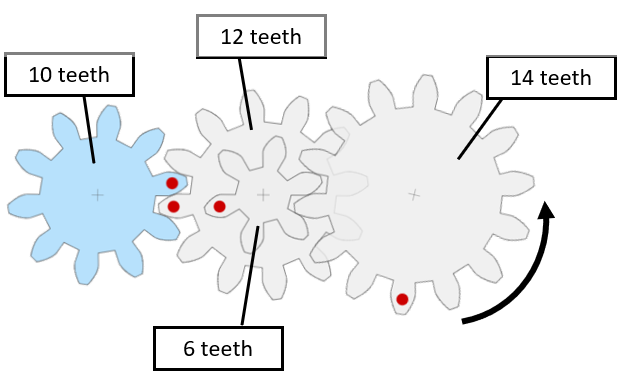
Data:
You need to use the Compound Gear trains equation to calculate the gear ratio:
\normalsize GR= \dfrac{Z_1 \cdot Z_3}{Z_2 \cdot Z_4} \normalsize GR= \dfrac{10 \cdot 6}{12 \cdot 14}=\dfrac{60}{168}=0,36Once you know the gear ratio the speed of the last wheel can be easily calculated knowing that, for all gear trains:
\normalsize GR=\dfrac{n_{last}}{n_{first}} \normalsize 0,36=\dfrac{n_{last}}{125} \normalsize n_{last}=0,36 \cdot 125 =45rpmSolution: \normalsize \mathbf{ n_{last}=45rpm }
*Problems 5 to 10.