Lesson 9:

The Ohm’s Law in a parallel circuit.
Now we are going to see how the Ohm’s Law can be applied to calculate the intensity and the voltage in a parallel circuit.
Given the following circuit, calculate:
- The intensity that leaves the battery.
- The intensity through each of its components.
- The voltage in each of its components.
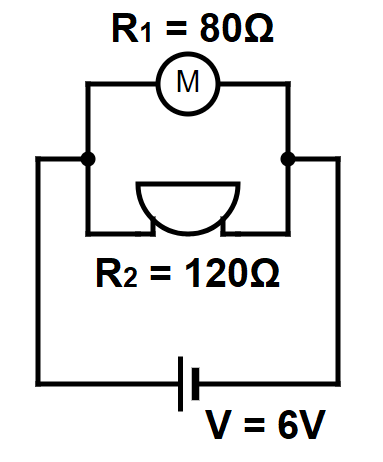
The first two steps are just the same than in the case of a series circuit. First you need to calculate the equivalent resistance, but in this case using the formula for parallel circuits:
\Large R_{eq}= \dfrac{1}{ \dfrac{1}{R_1} + \dfrac{1}{R_2}} = \dfrac{1}{ \dfrac{1}{80} + \dfrac{1}{120}} = 48 \OmegaNext the intensity that leaves the battery (Ibattery) must be calculated by applying the Ohm’s Law to the whole circuit, that is, using the equivalent resistance and the voltage of the battery:
\Large I_{battery}= \dfrac{V}{R_{eq}} = \dfrac {6}{48}=0,125A \approx 0,13AAs we’ve seen before, in a parallel circuit all the components have the same voltage, which is the same than the voltage of the battery, so we can directly say that:
\Large V_1=V_2=V_3=6VIt is that easy, there’s no need to do any other calculation. Nonetheless, you should specify that the reason why all those values are just the same is that you are working with a parallel circuit.
Finally, you’ll have to calculate the intensity of the currents that flow through each of the components. Before doing it I’d like you to try to answer the following question: through which of the two components do you think will flow a higher intensity?
Answering this question is quite easy if you remember that intensity is just the amount of electrons that an electric current carries. In a parallel circuit, the current that leaves the battery divides at some point into the different components of the circuit. The number of electrons that choose each of the possible paths will depend on the resistance of the components of each path. Obviously, the lower the resistance of a path the more electrons will choose this path, and the other way around.
It is something similar to what occurs when a group of people needs to leave a building, a cinema for example. Imagine the building has two exit doors. If both doors are the same width half of the people will leave through one of the doors and the other half will chose the oher door. However, if one of the doors is, let’s say, double in size around double of the people will take that way simply to reduce the jam.
The same happens with electrons. It is not that electrons are intelligent and decide to take one or another way. It is just that, automatically, electrons divide themselves according to how difficult it is to flow through each path. Therefore, in our example, there will be more electrons taking the path of the motor than the other ways for the only reason that the resistance of the motor is the lowest. So the intensity through the motor will be highest than the intensity through the buzzer. But now let’s calculate its exact value:
As we need to obtain the intensity the second formula of the Ohm’s Law must be used. In this case, we’ll have to apply this formula to each of the components individually:
- The intensity through the motor (component 1) is:
- The intensity through the buzzer (component 2) is:
The following table gathers all the solutions of the problem:
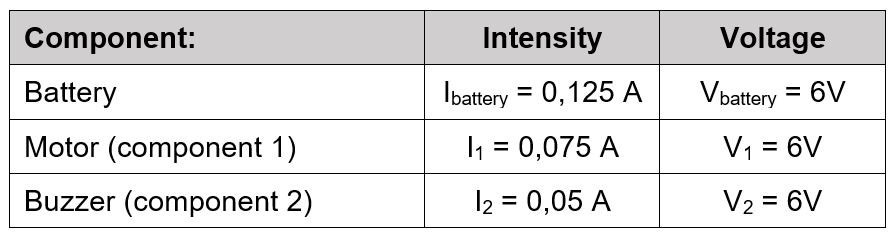
Very important! There’s an easy way to check that you haven’t made any mistake in this kind of exercises. Realize that if you add the intensities of each of the components the resulta is equal to the intensity that leaves the battery:
\Large I_1 + I_2 = 0,075 + 0,05 = 0,125AIt seems logical as the intensity that leaves the battery is divided into several paths with no electrons lost along the way. If the result of adding the intensities is not equal to the intensity of the battery it means that some mistake has been made at some point.