Lesson 10:

In this page, we are going to learn how to calculate the power and the energy of an electrical circuit and each of its components, using as an example the circuit of the previous page:
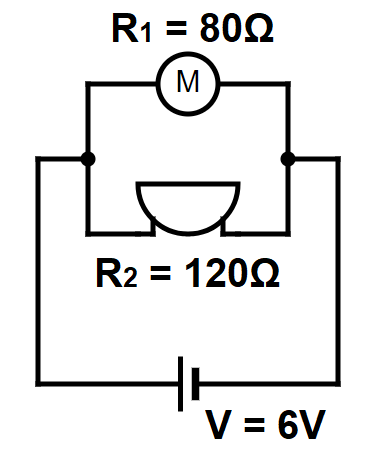
As the values of intensity and voltage in each of the components has been already calculated there is no need to do it again:Es decir, vamos a partir de los valores de voltaje e intensidad que se han calculado en dicho ejercicio:
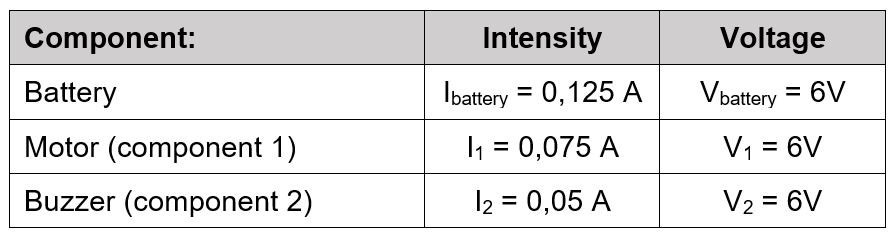
But if you were asked to calculate the power or the energy of a circuit whose values of intensity and voltage you don’t know the first step would be to calculate those quantities (as explaiend in the previous pages).
How to calculate the power.
As it has been explained on the fifth page of this unit, the electrical power of any electrical component can be obtained by multiplying its intensity by its voltage. Let’s see how to do it:
The power of an electrical component.
First of all, we are going to calculate the power of the two components (motor and buzzer) separately:
- The power of the motor (component number 1) will be obtained from the values of I1 and V1:
- The power of the buzzer (component number 2) will be obtained from the values of I2 and V2:
Total power of an electrical circuit.
The total power of a circuit is just the sum of the individual powers of its components, no matter how they are connected. In this case:
\Large P_T = P_1 + P_2 = 0,45 + 0,3 = \textbf{0,75W}But the total power can also be obtained from the intensity that leaves the battery and the voltage of the battery:
\Large P_T = V_{battery} \cdot I_{battery} = 6 \cdot 0,125 = \textbf{0,75W}As you can see, the final value is exactly the same regardless of the method used. If it wasn’t the same it would mean that some mistake has been committed at some point in the problem (maybe when calculating the intensities and voltages). For this reason, it is highly recommendable to check that the result is the same in both cases.
How to calculate the energy.
As explained in the fifth page of the unit, electrical energy is calculated multiplying the power of a component by the time that component is working (electric current passing through it). That’s why the time that a component or a circuit in connected must always be known in order to calculate the energy spent in that component or circuit.
In this case we are going to calculate the energy by each component y by the circuit as a whole if it is connected during 4 minutes.
Very important! Don’t forget that time must be indicated in it fundamental unit, which is the second (neither minutes nor hours) So, in this case, the first thing to do will be changing the time from minutes to seconds:
\large t = 4 min \cdot \dfrac{60s}{1min} = \textbf{240s}The energy consumed by each component.
To start we will calculate the electrical energy consumed by each component (motor and buzzer) individually:
- The energy consumed by the motor (component 1) is calculated as:
- The energy consumed by the buzzer (component 2) is calculated as:
Total energy consumed by a circuit.
The total energy consumed by a circuit in a certain amount of time is just the sum of the energies consumed by its components in that time. In our case:
\Large E_T = E_1 + E_2 = 108 + 072 = \textbf{180J}But, as it happened with power, there’s a second way to obtain the total energy of a circuit. If you multiply the total power of the circuit by the time that it has been working the result must be the same than with the previous method:
\Large E_T = P_T \cdot t = 0,75 \cdot 240 = \textbf{180J}As you can see the result is the same. If it wasn’t it would mean that some mistake has been made at some point.