Lesson 8:

Now that we’ve already remembered how to calculate the equivalent resistance of a series and a parallel circuit we are ready to learn how to apply the Ohm’s Law to circuits with several components. This way we’ll be able to calculate the intensity and the voltage in each component:
The Ohm’s Law in a series circuit
Let’s see how to apply the Ohm’s Law in a series circuit with a practical example:
Given the following circuit, calculate:
- The intensity that leaves the battery.
- The intensity through each of its components.
- The voltage in each of its components.
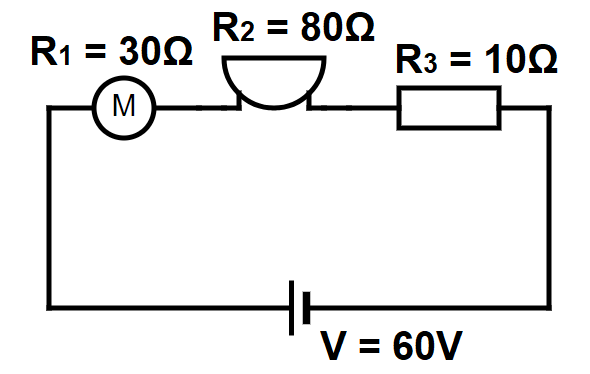
The first step is going to be to calculate the equivalent resistance. As, in this case, the three components are connected in series the equivalent resistance is calculated as:
\Large R_{eq}= R_1 + R_2 + R_3 = 30 + 80 + 10 =120 \OmegaNext, to calculate the intensity that leaves the battery (Ibattery) we are going to apply the Ohm’s Law to the whole circuit, that is, using the equivalent resistance:
\Large I_{battery}= \dfrac{V}{R_{eq}} = \dfrac {60}{120}=0,5AAs we’ve seen in the previous page, in a series circuit the intensity that flows through all the components is the same as the one that leaves the battery. So once we know that intensity we already know the intensity through each of the components:
\Large I_1=I_2=I_3=0,5AIt is that easy, there’s no need to do any other calculation. Nonetheless, you should specify that the reason why all those values are just the same is that you are working with a series circuit (in a parallel circuit it would be completely different).
Finally, we need to calculate the voltage in each of the components. But, before answering that question it would be great if you tried to answer this other question: in which of the three components the voltage will be higher?
To answer this question you must remember that the voltage is the «energy» of the electrons of an electric current. Each time the electrons need to go through a component they consume part of that «energy» due to the fact that all kinds of components have a certain resistance that makes it difficult for them to flow. The amount of «energy» that electrons consume in each component is just the voltage of that component.
Obviously, the higher the resistance of a component the higher the energy that electrons will loose when passing through it. Therefore, in our example, the component in which the most energy will be consumed is the buzzer, since it is the one with the highest electrical resistance of the three. That’s the reason why the highest voltage will be the one of the buzzer.
Now let’s calculate exactly the voltage of each component. As it is the voltage that we want to calculate, the first form of the Ohm’s Law is the one that we must use. However, in this case, we are going to apply that formula to each component individually:
- The voltage of the motor (component 1) is calculated as:
- The voltage of the buzzer (component 2) is calculated as:
- The voltage of the resistor (component 3) is calculated as:
The following table gathers all the solutions of the problem:
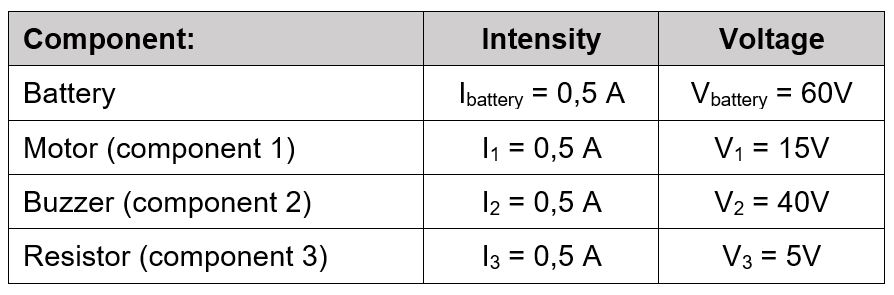
Very important! Once you’ve solved this kind of problems you can check that you haven’t made any mistake. Realize that, if you add the voltages of each component the result is equal to the voltage of the battery:
\Large V_1 + V_2 + V_3 = 15 + 40 + 5 = 60VIf this doesn’t happen it means that you’ve committed some mistake. The reason why this is always true is that the energy given by the battery to the electrons must be consumed along their journey back to the battery in the different components they go through. When the electrons return to the battery they’ll have lost all the energy the had when they left.