Lesson 7:

Series and parallel circuits.
In the previous page, we’ve seen how to apply Ohm’s Law in very simple circuits with just one battery and one component. However, real life circuits use to be made of several components, not just one. As you may remember, there are two basic ways in which components can be connected:
- Series circuit: that is, all the components in a straight line, one after the other. The circuit below is an example of a series circuit made of three bulbs and one resistor:
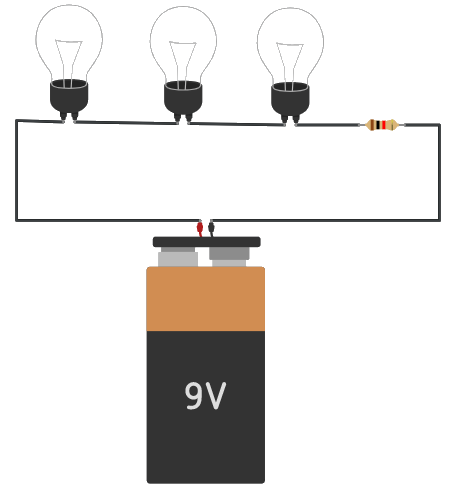
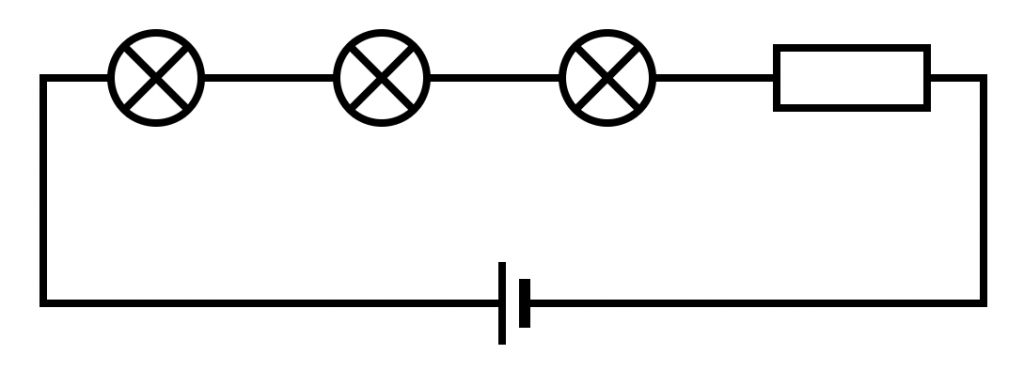
Very important! When several components are connected in series the number of electrons flowing through each of those components is exactly the same (because there’s just one path the can follow). Therefore, the intensity in all the components will be exactly the same. For example, if 2A flow through the first component 2A will flow through the las component as well. Electrons are not consumed along its way back to the battery!
- Parallel circuit: that is, all components connected to each other, left terminals together and right terminals together. The circuit below is an example of parallel circuit of a motor, a resistor and a buzzer:
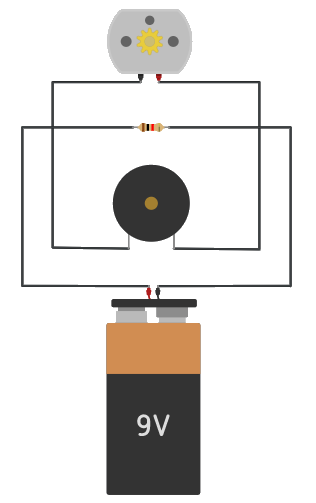
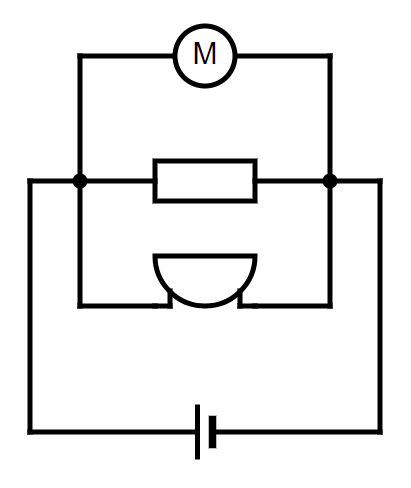
Very important! Realize that when several components are connected in parallel all of them are directly connected to the two poles of the battery. That’s why, the voltage in all of them is the same, and equal to the voltage of the battery.
How to calculate the equivalent resistance.
To apply the Ohm’s Law to a circuit of several components, whether they are connected in series or in parallel, the first step is to calculate the equivalent resistance (total resistance) of the whole circuit (you can remember it here). The only problem is that the equivalent resistance is calculated in a different way depending on the type of circuit (series or parallel).
The first example we are going to study is that of a series circuit. Imagine two motors and one buzzer are connected in series and their resistance is the one indicated in the image. How is the equivalent resistance calculated?
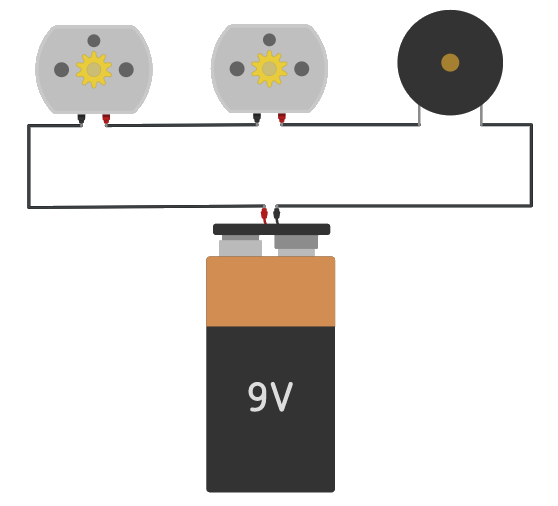
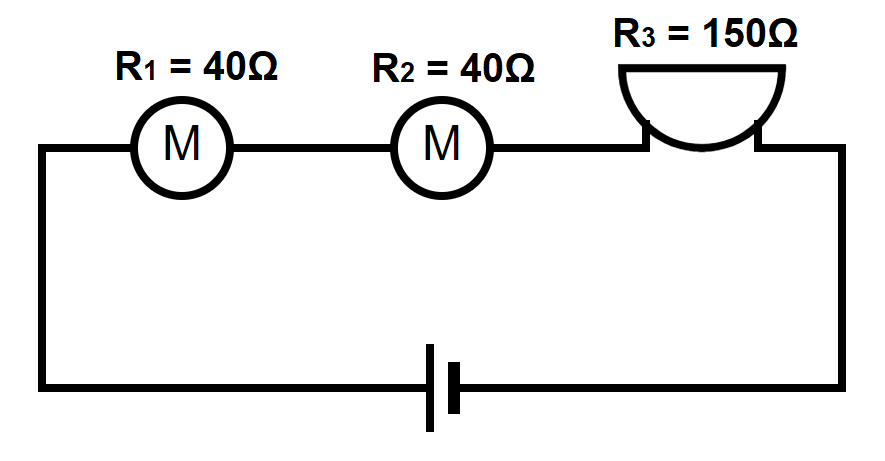
The equivalent resistance (Req) of a series circuit is just the sum of the individual resistances of all the components:
\Large R_{eq}= R_1 + R_2 + R_3 + ...In this case:
\Large R_{eq}= 40 + 40 + 150 = 230 \OmegaHowever, the way to calculate the equivalent resistance in a parallel circuit is quite different. Let’s see how to do it with the following example:
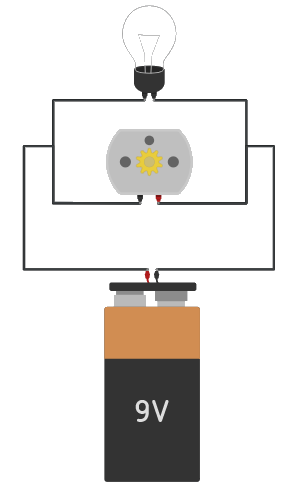
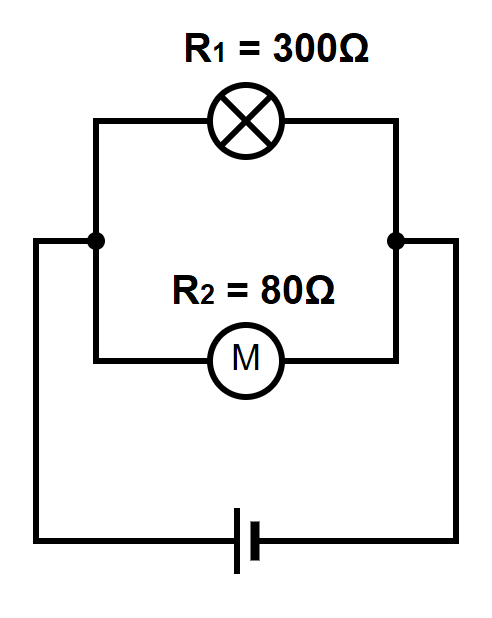
In the case of a parallel circuit this formula must be used:
\Large R_{eq}= \dfrac{1}{ \dfrac{1}{R_1} + \dfrac{1}{R_2} + \dfrac{1}{R_3} + ...}So, in our case, the equivalent resistance is:
\Large R_{eq}= \dfrac{1}{ \dfrac{1}{300} + \dfrac{1}{80}} = 63,16 \OmegaVery important! In a series circuit if a new component (with a certain resistance) is added the equivalent resistance will always increase. That is obvious, as the equivalent resistance is calculated by summing all the individual resistances.
On the other hand, just the opposite happens in a parallel circuit. If you add a new component (with a certain resistance), in parallel as well, to a parallel circuit the equivalent resistance will decrease. How is it possible? Easy, each time you connect a new component in a parallel circuit you are adding a new path that electrons can take to go back to the battery. Therefore the equivalent resistance of a parallel circuit will always be smaller than the smaller of the resistances. Surprising isn’t it?
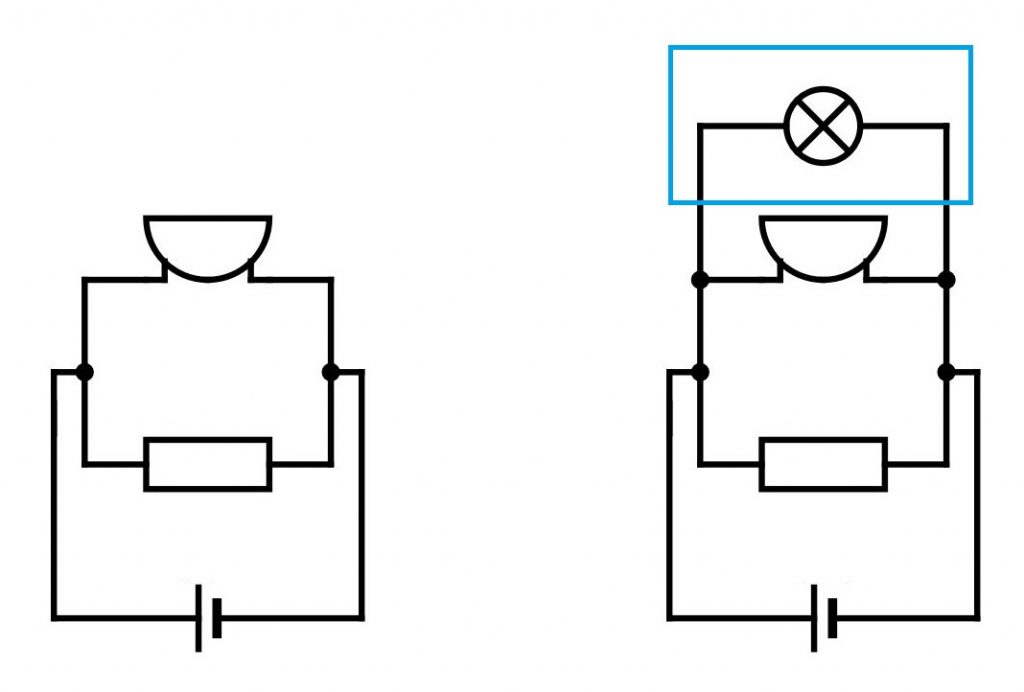
For instance, the circuit on the left is a parallel circuit of two components (one buzzer and one resistor). The circuit on the right is just the same, but a bulb has been added in parallel. As the values of resistance of the components are unknown we can’t calculate the value of their equivalent resistance. Nonetheless, we know, for sure, that the equivalent resistance of the circuit on the right will be lower than the equivalent resistance of the circuit on the left.