Lesson 6:

Ohm’s Law.
Last year we already studied how the three basic electrical quantities: intensity (I), voltage (V) and resistance (R), are related. That relation is called Ohm’s Law and says that:
\huge V=I \cdot RBut that equation can also be written in two other ways if we isolate the intensity or the resistance:
Basic problems with the Ohm’s Law.
Ohm’s law allows us to calculate, for example, the intensity of the current that leaves the battery of a circuit. Let’s start solving a very simple problem.
Problem 1: imagine an electrical motor with a 40Ω electrical resistance that is connected to 20V battery. What will be the intensity that goes out of the battery?
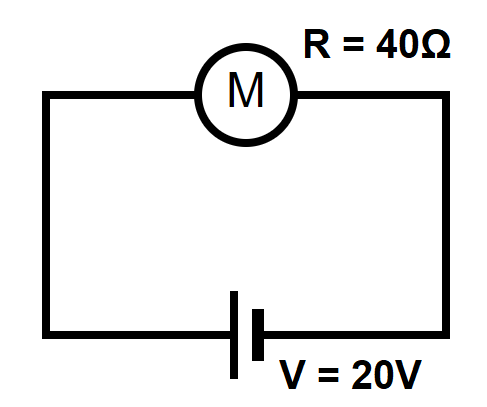
Data:
We can apply the second form of the Ohm’s Law to get the intensity:
\Large I= \dfrac{V}{R} = \dfrac{20}{40}=0,5AProblem 2: And if, instead of a 40Ω motor, it was a 60Ω resistor?
We are going to use Ohm’s Law to calculate the exact value of the intensity. But, beforehand, we can know whether the intensity will be higher or lower that in the previous case. The voltage of the battery remains the same while the electrical resistance has increased, what means that electrons will find it more difficult to flow through the circuit. Therefore we know that the intensity will be lower that in the case before.
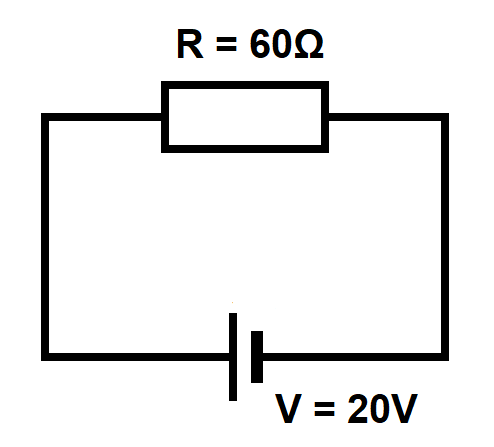
Data:
Applying Ohm’s Law to obtain the intensity, we get that:
\Large I= \dfrac{V}{R} = \dfrac{20}{60}=0,33AProblem 3: Finally, if the electrical component connected to the battery had a very low resistance, 5Ω for example, intensity will increase. Let’s see it:
\Large I= \dfrac{V}{R} = \dfrac{20}{5}=4ABut Ohm’s Law also allows us to calculate the voltage or the resistance of any component if two out of the three variables of the equation are known.
Problem 4: Calculate the voltage of the battery (which is the same than the voltage of the buzzer, because the circuit has only one component) if we know that intensity is 0,05A and the resistance of the buzzer is 100Ω:
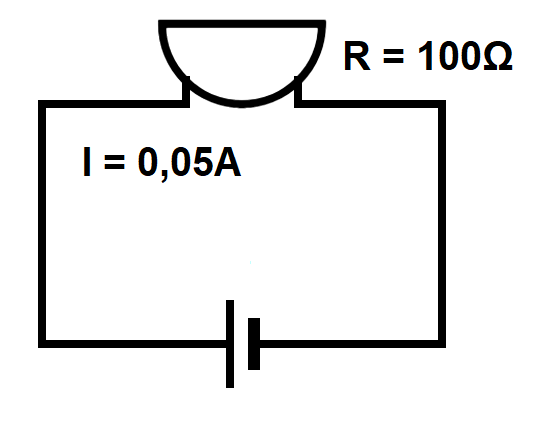
Data:
Applying Ohm’s Law to calculate voltage:
\Large V = I \cdot R = 0,05 \cdot 100=5VProblem 5: Calculate the resistance of a bulb connected to a socket of 230V knowing that the intensity of the current that flows through it is 0,3A.
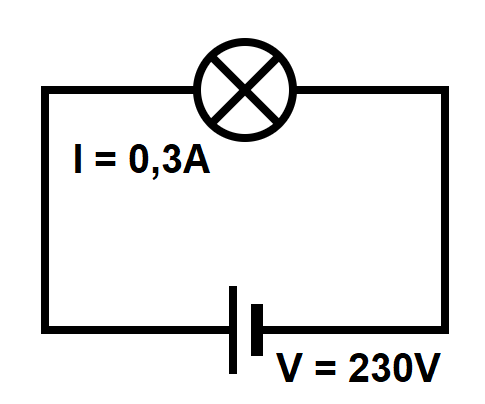
Data:
Aplying Ohm’s Law to get the resistance:
\Large R = \dfrac{V}{I} = \dfrac{230}{0,3} = 766,67 \Omega