Lesson 8:

Ohm’s Law in a circuit with several components.
The only difference between applying the Ohm’s Law in a circuit with a single component (as we have seen on the previous page) or with several components is that in the second case it is necessary to calculate the equivalent resistance.
Let’s see how to do it with two examples:
Problem 3: Calculate the intensity that leaves the battery in the circuit below:
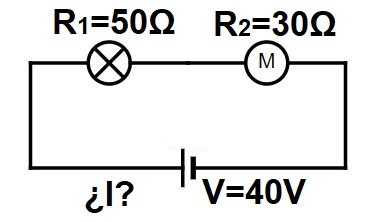
a) First the equivalent resistance is calculated, taking into account that it is a series circuit:
\large R_{eq}=R_{1}+R_{2}=50+30=80\Omegab) Then Ohm’s Law is applied to calculate the intensity.
\large I=\frac{V}{R-{eq}}=\frac{40}{80}=0,5AProblem 4: Calculate the voltage of the battery of the circuit below.
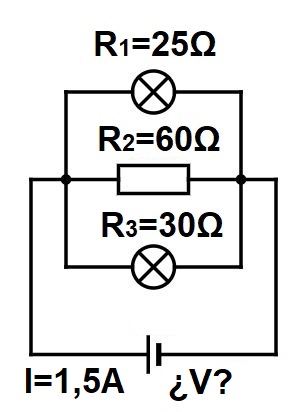
a) First the equivalent resistance is calculated, taking into account that it is a parallel circuit:
\large R_{eq}=\frac{1}{\frac{1}{R_{1}}+\frac{1}{R_{2}}+\frac{1}{R_{3}}}=\frac{1}{\frac{1}{25}+\frac{1}{60}+\frac{1}{30}}=11,11\Omegab) Then Ohm’s Law is applied to calculate the voltage.
\large V=I \cdot R_{eq}=1,5\cdot11,11=16,67VIf you click on the button you will find more exercises to practice the Ohm’s Law.