Lesson 7:

The equivalent resistance of a circuit.
Usually electrical circuits have more than one component. In that case, in order to apply Ohm’s Law propperly, the first step is to calculate the equivalent resistance of the circuit. The equivalent resistance of a circuit is the total resistance of the set of components of that circuit. The abbreviation for equivalent resistance is Req.
But there is one little problem, the equivalent resistance is not calculated in the same way if the components are connected in series as if they are connected in parallel.
How is the equivalent resistance of a series circuit calculated?
This is the easiest case. When a circuit consists of several components connected in series the equivalent resistance is just the sum of the resistances of all its components.
\Large R_{eq}=R_{1}+R_{2}+R_{3}+R_{4}+...Let’s see some examples…
– Circuit 1:
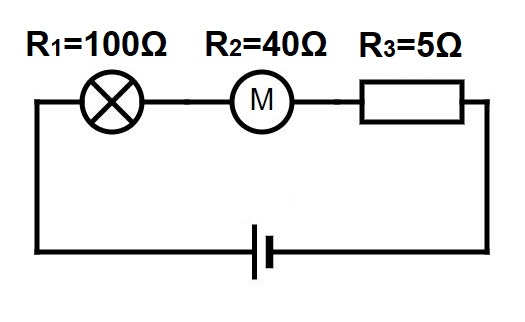
Its equivalent resistance is:
\large R_{eq}=R_{1}+R_{2}+R_{3}=100+40+5= 145 \Omega– Circuit 2:
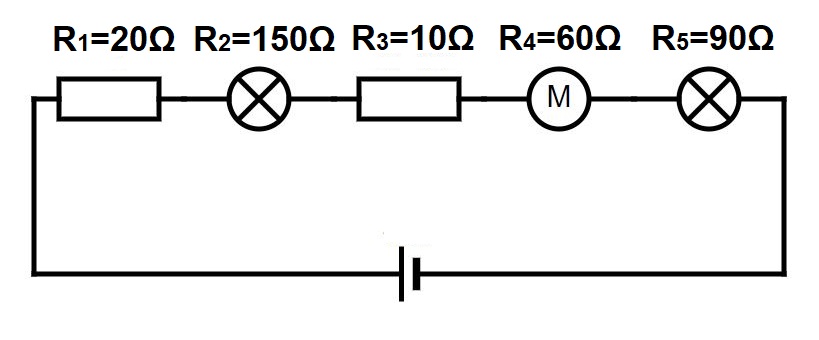
Its equivalent resistance is:
\large R_{eq}=R_{1}+R_{2}+R_{3}+R_{4}+R_{5}=20+150+10+60+90=330 \OmegaHow is the equivalent resistance of a parallel circuit calculated?
In this case, the way to calculate the equivalent resistance is completely different. When a circuit consists of several components connected in parallel to calculate the equivalent resistance, the following formula must be used.
\Large R_{eq}=\frac{1}{\frac{1}{R_{1}}+\frac{1}{R_{2}}+\frac{1}{R_{3}}+\frac{1}{R_{4}}+...}Let’s see some examples to make it clearer.
Calculate the equivalent resistance of the following circuits:
– Circuit 1:
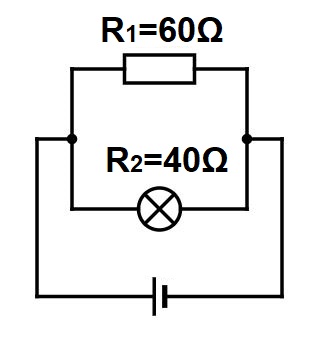
Its equivalent resistance is:
\large R_{eq}=\frac{1}{\frac{1}{R_{1}}+\frac{1}{R_{2}}}=\frac{1}{\frac{1}{60}+\frac{1}{40}}=24\OmegaSi dispones de una calculadora en la que se pueden introducir fracciones lo más sencillo es introducir toda la fórmula directamente. Si, por el contrario, dispones de una calculadora más básica que sólo permita realizar operaciones básicas puedes seguir los siguientes pasos:
a) Calculate the values of the fractions of the denominator:
\large \frac{1}{R_{1}}=\frac{1}{60}=0,017; \frac{1}{R_{2}}=\frac{1}{40}=0,025You should always take two decimal places (different from zero) as we’ve done above, since if you only take one figure the final result may not be very precise.
b) Sum up all those values:
\large 0,017+0,025=0,042c) And finally calculate the inverse of the previous result. That is, 1 devided by that value:
\large R_{eq}=\frac{1}{0,042}=23,8\OmegaThe result may vary by a few decimal places depending on the method used, but it will always be very similar.
– Circuit 2:
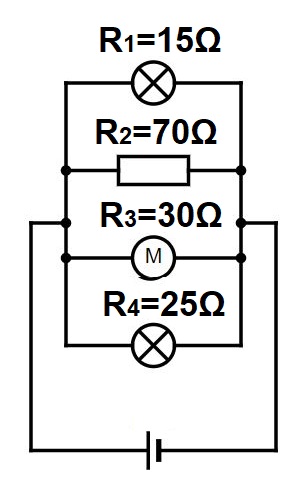
Its equivalent resistance is:
\large R_{eq}=\frac{1}{\frac{1}{R_{1}}+\frac{1}{R_{2}}+\frac{1}{R_{3}}+\frac{1}{R_{4}}}=\frac{1}{\frac{1}{15}+\frac{1}{70}+\frac{1}{30}+\frac{1}{25}}=6,48\OmegaYou can try to calculate the result step by step as indicated in the first exercise to verify that the result is the same.