Lesson 6:

How much current flows through a circuit?
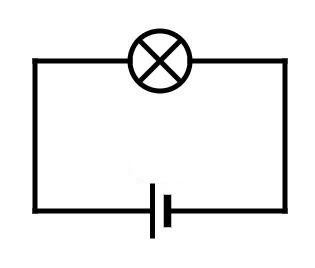
Imagine that we just connect a light bulb to a battery. As we have seen before, the battery will push the electrons through the circuit wires and cause the bulb to light up permanently (at least until it runs out). The electrical diagram of that circuit would be:
There is a great variety of batteries and each of them provides a certain voltage. In fact, if you look at any battery you will see that its voltage is written somewhere: 1.5V, 3V, 9V …
Some of the most frequently used batteries are:
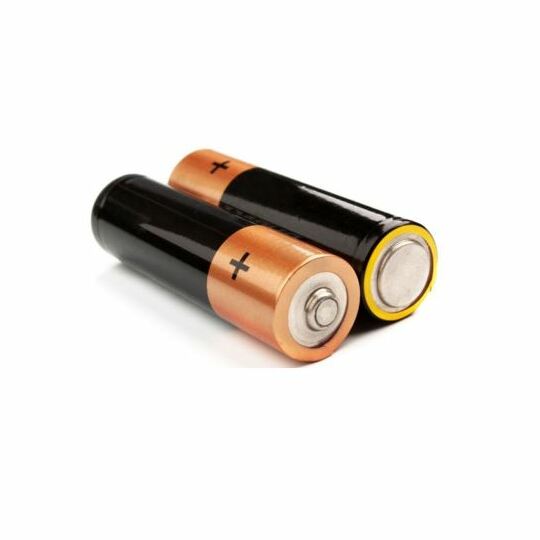
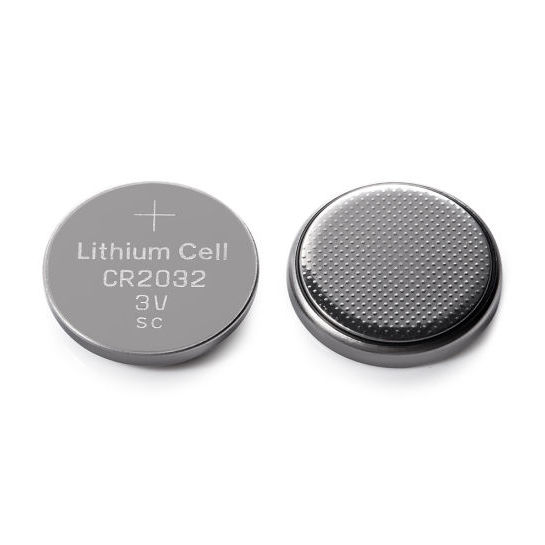


Therefore, depending on the battery model the electric current flowing through the circuit will be bigger or smaller.
Next we are going to learn how to calculate the number of electrons that circulate in a circuit depending on the battery we use. Of course, the higher the value of the battery, the greater the current that will flow, but how much exactly? In order to calculate it, you need to learn a new concept: the electrical resistance.
Electrical resistance.
To understand what the electrical resistance is, you can compare the electrons of an electric current circulating through a wire with the tiny drops of water that travel through a pipe. As they move through the circuit, electrons pass through the electrical components of the circuit. Each of the electrical components of the circuit is a small obstacle for the electrons. That’s why in order to flow through them electrons lose some of the energy that the battery had given them.
The electrical resistance of an electrical component represents how much an electrical component opposes the flow of electrical current.

A component with a high electrical resistance is a component that electrons have a hard time going through. Conversely, a component with low electrical resistance is a component that electrons can pass through without too much «effort», that is, without losing much energy. The abbreviation for electrical resistance is the letter R.
As it happened with intensity and voltage, resistance also has its unit of measurement, in this case the ohm, which is abbreviated with the letter Ω (omega) which is the letter O in Greek.
Each component has some electrical resistance. For example, a small motor may have around 30Ω of resistance and a light bulb around 800Ω.
Ohm’s Law.
There is a relationship between electrical intensity, voltage, and electrical resistance. This relationship is known as Ohm’s Law since it was discovered by scientist George Ohm.
What Ohm discovered is that the higher the electrical resistance of a component, the lower the electrical intensity (the number of electrons) that can circulate through it. It is actually very logical. If the electrical resistance represents the difficulty that electrons have to pass through a component, it is obvious that if the electrical resistance is high very few electrons will be able to pass through it.
Ohm’s Law is represented with this equation:
\huge V=I \cdot RWhich means that voltage is equal to the electrical intensity multiplied by the resistance.
Problem 1: Calculate the voltage of the battery knowing that the resistance of the motor is 40Ω and an electrical intensity of 2A flow through it.
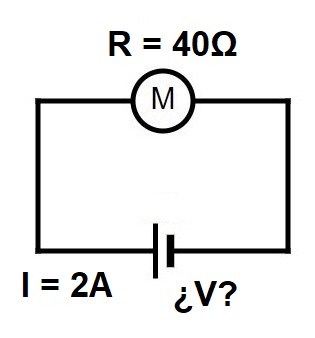
Applying Ohm’s Law…
\large V=I \cdot R=2\cdot40=80VBut what happens if you know the values of voltage and resistance but the intensity is unknown? In that case, you must clear the intensity (I) in the previous equation (as you do in the Equations unit of maths):
\huge I=\frac{V}{R}Which means that the electrical intensity is equal to the voltage divided by the resistance.
Now, you should already know how to solve the following problem:
Problem 2: Calculate the intensity that flows through the circuit if the voltage of the battery is 20V and the resistance of the buzzer is 5Ω.
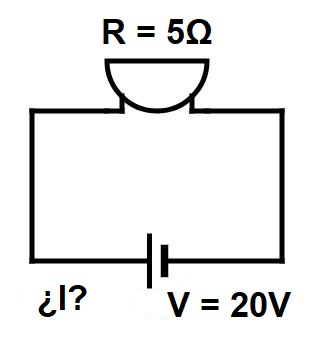
The solution is:
\large I=\frac{V}{R}=\frac{20}{5}=4AFinally, what will happen if we know both the voltage and the intensity and we want to calculate the resistance of the component? In that case we must clear the resistance (R) in the equation:
\huge R=\frac{V}{I}Which means that the electrical resistance is equal to the voltage divided by the intensity.
Problem 3: Calculate the electrical resistance of the bulb if you know that the battery provides 40V and the intensity that flows through the circuit is 0,2A.
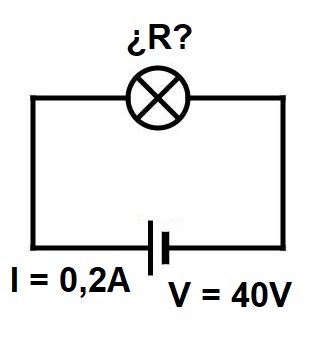
Applying Ohm’s Law…
\large R=\frac{V}{I}=\frac{40}{0,2}=200\OmegaWe have already seen how to calculate the voltage, intensity or resistance in very simple circuits made of one battery and one component. On the next page we will see how to calculate these values when there is more than one component in the circuit.